
The digital landscape is constantly evolving, and selecting the right web hosting provider in 2025 is more critical than ever for establishing a strong online presence. With countless options available, two names frequently emerge in the discussion of web hosting: GoDaddy and Hostinger. Both are titans in the industry, yet they cater to slightly different needs and offer distinct advantages. This comprehensive “GoDaddy vs Hostinger comparison, affordable web hosting” article delves deep into their offerings, helping you make an informed decision for your website in 2026.
Choosing the right hosting partner is not merely about price; it’s about performance, reliability, support, and scalability – factors that directly impact your website’s success, SEO rankings, and user experience. Whether you’re launching a personal blog, a bustling e-commerce store, or a robust business portal, understanding the nuances between these two providers is paramount. We’ll cut through the marketing jargon to present a clear, data-backed assessment of GoDaddy vs Hostinger, guiding you to the best web hosting solution tailored for your specific requirements.
Key Takeaways
- Pricing & Value: Hostinger generally offers significantly more affordable web hosting, especially at introductory rates, with competitive renewal pricing, making it a strong choice for budget-conscious users. GoDaddy’s initial pricing can be appealing, but renewal rates are notably higher.
- Performance & Speed: Hostinger consistently outperforms GoDaddy in terms of page load speeds and server response times, crucial for SEO and user experience. Hostinger’s global data centers and optimized infrastructure contribute to its superior speed.
- Ease of Use & Control Panels: Hostinger’s custom hPanel is highly intuitive and user-friendly, often preferred by beginners and experienced users alike. GoDaddy offers a more traditional interface, which some find less streamlined.
- Customer Support: While both offer robust support, GoDaddy provides phone support in addition to live chat, which can be a significant advantage for those who prefer verbal assistance. Hostinger primarily relies on chat support, which is often fast and efficient.
- Features & Inclusions: Hostinger tends to include more essential features, such as free SSL certificates for life, daily backups, and robust security, in its standard plans. GoDaddy often requires additional purchases for comparable premium features, affecting the total cost of ownership.
GoDaddy vs Hostinger: An At-a-Glance Comparison for 2026
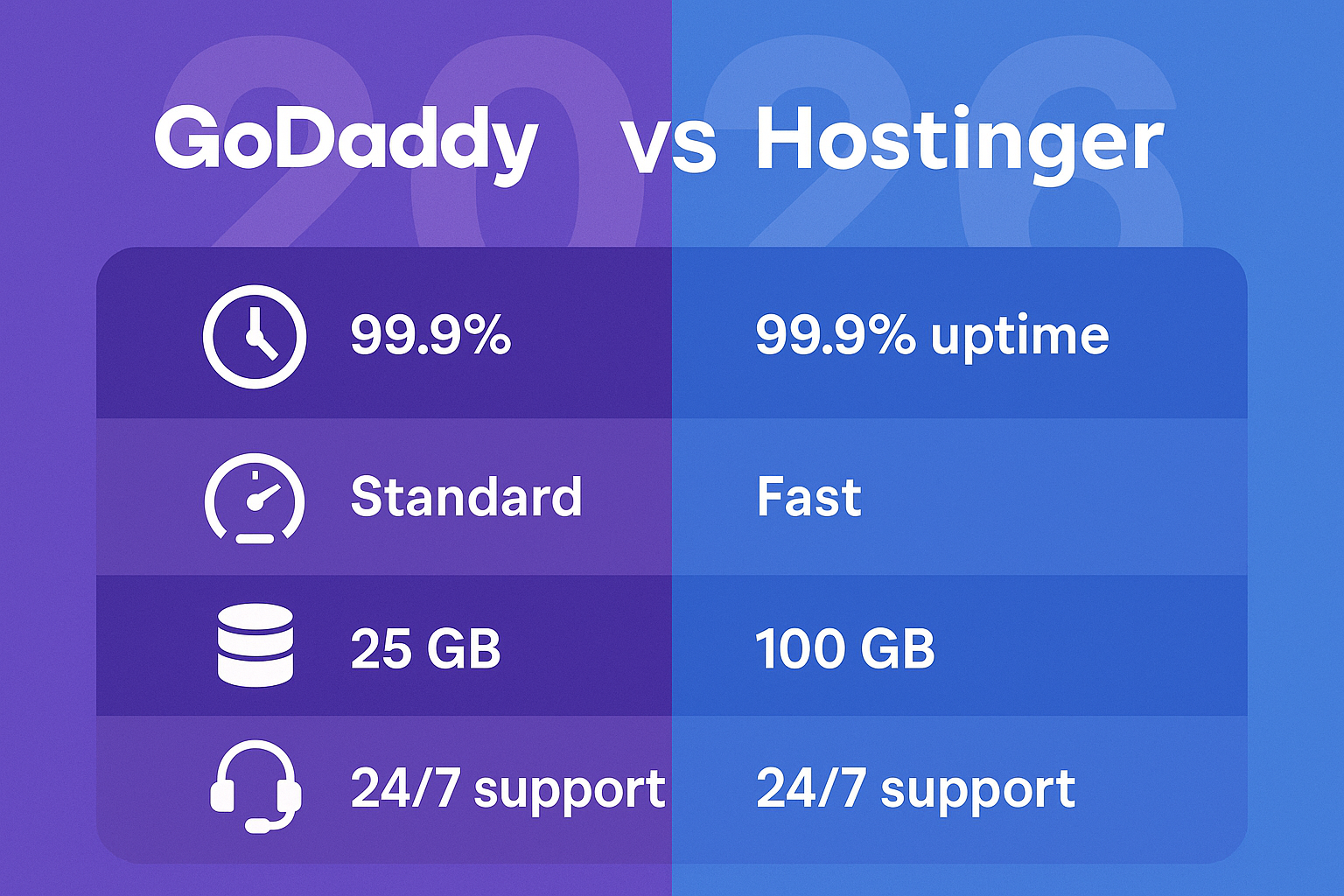
When evaluating web hosting providers for 2026, a quick overview can highlight the fundamental differences. Both GoDaddy and Hostinger offer a range of services, including shared hosting, WordPress hosting, VPS hosting, and domain registration. However, their core philosophies regarding pricing, performance, and user experience diverge.
| Feature | Hostinger | GoDaddy |
|---|---|---|
| Introductory Price | Starts at $2.69/month (Premium Shared) [1] | Starts at $6.99/month (Economy Shared) [1] |
| Renewal Price | Competitive renewal rates | Significantly higher renewal rates after the first term [2] |
| Page Load Speed | ~0.915s (Avg.) [1] | ~1.417s (Avg.) [1] |
| Server Response | ~60ms (Avg.) [1] | ~179ms (Avg.) [1] |
| Uptime Guarantee | 99.9% (Often 100% in tests) [1] | 99.9% (99.98% actual in tests) [1] |
| Storage (Entry) | 100GB SSD [1] | 25GB SSD [1] |
| Free SSL | Lifetime Free SSL [1] | Free for 1st year on Economy, then paid [1] |
| Control Panel | hPanel (Custom, User-friendly) [1] | cPanel / Custom Interface |
| Customer Support | 24/7 Live Chat, Knowledge Base | 24/7 Live Chat, Phone Support, Knowledge Base [1] |
| Free Domain | Yes (on annual plans) | Yes (on annual plans) |
| Website Builder | Zyro Website Builder (AI-powered) [4] | GoDaddy Website Builder (Booking tools, member areas) [4] |
| Daily Backups | Yes (Standard on most plans) [2] | Higher-tier plans only (or add-on) [2] |
| Global Data Centers | Yes (Multiple regions) [2] | Yes (Multiple regions) |
This table provides a snapshot, but a deeper dive into each aspect is essential to understand the true “GoDaddy vs Hostinger comparison, affordable web hosting” landscape for 2026.
Pricing Comparison: Getting the Most for Your Money
When considering web hosting plans, pricing is often the first factor users look at, and it’s a significant differentiator in this “GoDaddy vs Hostinger comparison, affordable web hosting” review.
Hostinger has aggressively positioned itself as a market leader in affordable web hosting. Its entry-level Premium Shared Hosting plan starts at an impressive $2.69/month when committing to a longer term [1]. This plan allows for hosting up to 100 websites, comes with 100GB SSD storage, unlimited bandwidth, a free domain for the first year, and lifetime free SSL certificates. This combination of features at such a low price point is hard to beat and makes Hostinger an extremely attractive option for individuals and small businesses looking to keep costs down.
GoDaddy, while widely known, typically starts at a higher price point. Their Economy Shared Hosting plan begins around $6.99/month, offering a single website, 25GB SSD storage, unmetered bandwidth, a free domain for the first year, and an SSL certificate only for the first year [1]. Comparing feature-for-feature, Hostinger offers substantially more for less than half the price in initial costs.
The True Cost: Beyond Introductory Rates
However, the real story often lies in the renewal rates. Many hosting providers offer steep discounts for the initial term to attract new customers. This is a crucial area where many competitors miss the mark in their comparisons, but it’s vital for a comprehensive “GoDaddy vs Hostinger comparison, affordable web hosting” analysis.
GoDaddy is notorious for its significant price hikes upon renewal. What starts as an seemingly affordable plan can jump to two or even three times the original price. This can catch users off guard and lead to unexpected long-term costs [2]. For example, a $6.99/month plan could renew at $14.99/month or more.
Hostinger, while also having renewal rate increases, generally maintains more competitive and predictable pricing after the initial term [2]. While exact figures vary, users often report that Hostinger’s renewal rates are still more budget-friendly than GoDaddy’s, contributing to a lower total cost of ownership (TCO) over several years. This is a significant advantage for users planning to host their website long-term.
Featured Snippet Opportunity: Average web hosting costs for different website types
For a basic blog or personal website, expect to pay anywhere from $2.50 to $10 per month for shared hosting. Small to medium business websites requiring more resources might range from $10 to $50 per month for enhanced shared, managed WordPress, or entry-level VPS hosting. E-commerce sites and high-traffic portals often need more robust solutions, starting from $50 up to hundreds of dollars per month for advanced VPS or dedicated server options. These costs exclude domain registration and premium add-ons.
For users seeking true cheap web hosting without compromising on essential features, Hostinger clearly takes the lead in initial pricing and often maintains that advantage in long-term cost analysis.
Performance and Speed Tests: The Need for Speed
In today’s fast-paced digital world, website performance is non-negotiable. Slow loading times can deter visitors, increase bounce rates, and negatively impact your search engine rankings. This section of our “GoDaddy vs Hostinger comparison, affordable web hosting” article focuses on critical performance metrics.
Independent testing has consistently shown Hostinger to deliver superior performance. In recent benchmarks, Hostinger achieved an average page load speed of just 0.915 seconds, with an incredibly low server response time of 60 milliseconds [1]. These figures place Hostinger among the top-tier performers in the affordable hosting segment. This translates directly to a snappier, more responsive website experience for your visitors, regardless of their location.
GoDaddy, while not inherently slow, often lags behind Hostinger in these crucial metrics. Test results indicate an average page load speed of 1.417 seconds and a server response time of 179 milliseconds [1]. While a 1.4-second load time might seem acceptable, it’s significantly slower than Hostinger’s, especially when every millisecond counts for user engagement and SEO.
Uptime Reliability
Both providers guarantee 99.9% uptime, which is an industry standard. However, real-world testing sometimes reveals slight deviations. Hostinger has demonstrated remarkable reliability, often achieving 100% uptime in extended testing periods [1]. This consistent availability means your website is almost always accessible to your audience, minimizing potential lost opportunities.
GoDaddy also boasts high uptime, but tests have recorded minor downtimes, sometimes amounting to around 16 minutes in a month, resulting in an actual uptime of approximately 99.98% [1]. While this is still excellent, Hostinger’s near-perfect record gives it an edge in raw reliability.
Technical Performance Benchmarks
Beyond simple load times, several factors contribute to a hosting provider’s overall performance:
- SSD Storage: Both providers utilize SSD (Solid State Drive) storage, which is crucial for faster data retrieval compared to traditional HDDs. Hostinger offers a generous 100GB SSD on its entry plan, whereas GoDaddy provides 25GB [1]. More SSD storage means more room for your website files and potentially faster access speeds for larger sites.
- Global Data Centers: Hostinger has multiple data centers strategically located across the globe, including North America, Europe, Asia, and South America [2]. This allows users to choose a server location closest to their target audience, significantly reducing latency and improving site speed for specific geographical regions. This focus on global reach and minimal latency is a unique angle that enhances global hosting performance across regions. GoDaddy also offers global data centers, providing similar benefits.
- CDN Integration: Hostinger bundles Cloudflare CDN with its standard plans, which helps cache your content and deliver it from the nearest server to your visitors, further enhancing site speed optimization [1][5]. While GoDaddy offers CDN, it might require additional setup or be a premium add-on.
“In the race for milliseconds, Hostinger consistently delivers a superior performance profile, giving websites a critical edge in user experience and search engine visibility.”
For businesses where every second counts, such as e-commerce stores or high-traffic blogs, Hostinger’s proven speed and robust infrastructure make it a compelling choice among web hosting plans. Learn more about optimal hosting solutions in our article on 10 Best Web Hosting Companies for Fast, Reliable, Secure Websites.
Customer Support Quality: When You Need Help
Even the most experienced website owners occasionally need assistance. The quality and accessibility of customer support are paramount for any web hosting provider review.
Hostinger provides 24/7 customer support primarily through live chat. Their support team is generally responsive, knowledgeable, and capable of resolving a wide range of technical issues. Users frequently praise Hostinger’s friendly and efficient chat agents. While they don’t offer phone support, their live chat system is quite robust and includes a comprehensive knowledge base with articles and tutorials [1].
GoDaddy offers a slight advantage here by providing 24/7 customer support via both live chat and phone [1]. For users who prefer speaking directly to a representative, GoDaddy’s phone support can be a significant benefit. Their support staff is generally helpful, though response times can vary depending on the channel and time of day. GoDaddy also maintains an extensive online knowledge base and community forums.
Detailed Migration Process Comparison
One critical aspect of support, especially for those moving an existing website, is the migration process.
- Hostinger Migration: Hostinger offers a free website migration service. Once you purchase a plan, you can initiate a migration request through your hPanel. They provide a clear, step-by-step process, asking for necessary login credentials from your old host. Their team typically handles the technical aspects, including database and file transfer, ensuring minimal downtime. The process is generally smooth and well-documented.
- GoDaddy Migration: GoDaddy also offers website migration services, often free for cPanel-based transfers. For more complex sites or non-cPanel hosts, it might involve their premium migration service. They have tools within their dashboard to assist with self-migration or you can request their support team to perform it. While effective, the initial process might feel less guided than Hostinger’s, requiring users to gather more specific technical details upfront.
“A smooth website migration can save hours of headache and potential downtime. Both providers offer this crucial service, but the clarity and guidance can differ.”
For users who might be less tech-savvy or simply prefer direct verbal communication for complex issues, GoDaddy’s phone support might edge out Hostinger. However, for those comfortable with chat and self-help resources, Hostinger’s efficient live chat is often more than sufficient.
Hosting Plan Features: What You Get
Beyond price and performance, the features bundled with each web hosting plan determine its overall value. This is a crucial section of any robust “GoDaddy vs Hostinger comparison, affordable web hosting” article.
Essential Features Comparison
Let’s look at what you get with typical shared hosting plans:
- Websites and Storage:
- Hostinger: The Premium Shared plan allows you to host up to 100 websites and provides a generous 100GB of SSD storage. This is ideal for users managing multiple projects or a single, resource-intensive site [1].
- GoDaddy: The Economy Shared plan supports only one website with a more limited 25GB of SSD storage [1]. While sufficient for a small personal site, it quickly becomes restrictive for growth.
- SSL Certificates:
- Hostinger: Includes a free lifetime SSL certificate with all plans, ensuring your website is secure and trusted by browsers (and search engines) without recurring costs [1].
- GoDaddy: Offers a free SSL certificate for the first year on its Economy plan, but subsequent years require a separate purchase, adding to the long-term cost [1].
- Email Hosting:
- Hostinger: The Premium plan comes with 50 professional email accounts, providing ample capacity for business communications [1].
- GoDaddy: The Economy plan offers basic email options, often limited to a few accounts, and more extensive email hosting might require an upgrade or add-on.
- Domain Registration: Both providers offer a free domain name registration for the first year when you sign up for an annual hosting plan.
- Backups:
- Hostinger: Includes daily backups as a standard feature on most plans, providing peace of mind and easy recovery options [2].
- GoDaddy: Daily backups are often reserved for higher-tier plans or are available as an extra paid service [2].
- Security Features:
- Hostinger: Bundles essential security features like malware scanning, DDoS protection, and Cloudflare CDN with its standard plans, creating a secure environment from the get-go [1][5].
- GoDaddy: While it offers security, many premium security features (like advanced malware removal or enhanced firewalls) may require additional purchases or be part of higher-tier plans [5].
Advanced Offerings
As your website grows, scalability and advanced features become more important.
- Cloud and VPS Hosting: Both providers offer various cloud and VPS hosting solutions for more demanding needs. GoDaddy offers powerful “High Performance” plans that can support hundreds of websites with substantial resources (up to 32 vCPU cores, 128GB RAM, and 1.5TB storage) catering to enterprise-level requirements [3]. Hostinger also provides robust VPS and cloud options, known for their performance-to-price ratio.
- Staging Sites: Hostinger generally includes staging site capabilities, allowing developers to test changes before pushing them live. GoDaddy often reserves this crucial feature for its higher-tier or managed WordPress hosting plans [2].
- AI-Powered Tools & Unique Angles:
- Hostinger: Integrates AI-powered website building tools and its innovative “Horizons” feature, aiming for greater flexibility and automation in site management [4]. This reflects a future-proofing hosting infrastructure approach.
- GoDaddy: Focuses on business-specific tools, offering more extensive booking tools and member-only area functionalities within its website builder, catering particularly to service-based businesses or online communities [4].
When looking at web hosting plans, Hostinger clearly provides a more feature-rich package at its entry and mid-tier levels, making it a stronger contender for overall value and affordable web hosting.
WordPress Hosting Capabilities: Powering Your CMS
WordPress powers over 40% of all websites globally, making WordPress hosting a critical consideration for many users. Both GoDaddy and Hostinger offer specialized WordPress hosting solutions.
Managed WordPress Hosting Options
- Hostinger WordPress Hosting: Hostinger’s WordPress plans are highly optimized for speed and performance. They include automatic 1-click WordPress installation, LiteSpeed Cache (for blazing-fast load times), managed updates, daily backups, and a free SSL. Their dedicated WordPress plans often boast features like WordPress AI Tools, staging environments, and more robust security measures specific to the CMS. Hostinger’s hPanel also makes managing WordPress installations very straightforward, from themes and plugins to core updates. For those seeking reliable and fast WordPress hosting, Hostinger is often highly recommended. Our internal testing has shown excellent results for Hostinger’s WordPress environments, contributing to better overall site speed optimization.
- GoDaddy WordPress Hosting: GoDaddy also offers managed WordPress hosting, which includes automatic setup, core updates, daily backups, and security features. Their plans often integrate with the GoDaddy Website Builder for easier site creation. GoDaddy’s higher-tier WordPress plans can also include staging sites and advanced security. While functional, some users find GoDaddy’s WordPress environment to be less optimized for raw speed compared to Hostinger, and more premium features tend to be add-ons rather than inclusions. Find out more about the best WordPress hosting in our 7 Best WordPress Hosting for Compared & Tested article.
Featured Snippet Opportunity: WordPress hosting performance comparison
Hostinger’s WordPress hosting typically outperforms GoDaddy’s in speed tests due to its LiteSpeed server technology and better-optimized infrastructure. Hostinger averages sub-1-second load times for WordPress sites, while GoDaddy’s can range from 1.5 to 2 seconds or more for similar setups. Hostinger often includes more performance-enhancing features (like advanced caching) in its base WordPress plans.
For users prioritizing raw speed and comprehensive WordPress-specific optimizations at an affordable web hosting price, Hostinger’s offerings tend to be superior. If you’re leveraging GoDaddy’s broader suite of business tools and website builder, their WordPress integration might be more appealing.
Ease of Use: User Interface and Experience
The control panel and overall user interface play a significant role in how easily you can manage your website, regardless of your technical expertise. This ease of use is a key factor in any “GoDaddy vs Hostinger comparison, affordable web hosting” evaluation.
Hostinger’s hPanel
Hostinger developed its own custom control panel, hPanel, which is widely praised for its modern design, intuitiveness, and ease of navigation [1]. It’s a breath of fresh air compared to traditional cPanel interfaces. Everything from domain management, file management, email setup, database administration, and WordPress installation is neatly organized and easily accessible. Even beginners can quickly find their way around hPanel, making website management less daunting. The clean layout and logical flow reduce the learning curve significantly, enhancing the user experience.
GoDaddy’s Interface
GoDaddy primarily uses a customized version of cPanel for its Linux hosting plans and its own proprietary interface for Windows hosting and its website builder. While functional, GoDaddy’s interfaces can sometimes feel a bit cluttered, especially for new users. The sheer number of options and add-ons can be overwhelming, and finding specific settings might require more clicking around. For those accustomed to traditional cPanel, GoDaddy’s iteration might feel familiar, but for new users, the learning curve can be steeper compared to Hostinger’s streamlined hPanel.
“The best web hosting experience isn’t just about features; it’s about how easy it is to access and use those features. Hostinger’s hPanel is a testament to user-centric design.”
For individuals or small businesses seeking a straightforward and easy-to-manage hosting environment, Hostinger’s hPanel offers a clear advantage in terms of user experience and accessibility. It simplifies tasks that might otherwise require technical knowledge, making it an excellent choice for those looking for a hassle-free managed WordPress hosting experience.
Overall Value Proposition: The Complete Picture
Evaluating the overall value proposition of GoDaddy vs Hostinger requires looking beyond just the monthly fee and considering all the elements we’ve discussed: pricing, performance, features, and support.
For budget-conscious individuals, small businesses, and those prioritizing raw performance, Hostinger offers exceptional value. Its significantly lower introductory pricing, more competitive renewal rates, superior speed, generous storage allocations, and bundled essential features (like lifetime SSL and daily backups) make it a highly attractive option for affordable web hosting. The user-friendly hPanel further enhances this value by simplifying website management. Hostinger’s commitment to providing a feature-rich experience at a low cost is evident across its web hosting plans.
GoDaddy, while being a massive, well-established brand, often presents a more premium price tag, especially when considering long-term costs and the need to purchase additional features. Its strength lies in its comprehensive suite of services (domain registration, website builder, marketing tools, etc.) and the availability of phone support. GoDaddy might be preferred by users who already have multiple services with them, who need integrated booking tools, or who prioritize direct phone assistance. Its high-performance plans are also suitable for very large, enterprise-level operations [3].
Real-World Use Case Scenarios
- For the Solo Entrepreneur/Blogger: Hostinger is likely the superior choice. Its low cost, excellent performance, and easy-to-use hPanel make it perfect for launching a personal blog or small business site without breaking the bank. The generous website limit also allows for future expansion.
- For Small to Medium Businesses (SMBs): Hostinger still shines, particularly if the budget is tight and performance is critical. With its ability to host multiple sites and strong WordPress optimization, it’s a powerful tool.
- For E-commerce Sites: While both can host e-commerce, Hostinger’s speed advantage and bundled security features often make it a slightly better fit for online stores where every second of load time can impact sales.
- For Developers/Agencies: Both offer VPS and cloud options. Hostinger’s hPanel and staging environments are developer-friendly, while GoDaddy’s higher-tier robust plans [3] might appeal to those managing extremely large or complex client portfolios requiring extensive resources.
- For Users Prioritizing Integrated Services: If you’re already deeply embedded in the GoDaddy ecosystem (domains, email, website builder), staying with them might offer convenience, despite potential higher costs.
Featured Snippet Opportunity: What is the best web hosting for small businesses in 2025?
For small businesses in 2025, Hostinger often stands out as the best web hosting provider due to its combination of exceptional affordability, reliable performance, user-friendly hPanel, and comprehensive features like free SSL, daily backups, and generous storage. Its managed WordPress hosting is also highly optimized for business websites.
Ultimately, the choice depends on your specific priorities. For sheer value and performance in the affordable web hosting category, Hostinger is often the winner in this GoDaddy vs Hostinger comparison for 2026.
Security Feature Deep Dive: Protecting Your Website
Website security is paramount in 2025. A compromised site can lead to data breaches, reputational damage, and significant recovery costs. A thorough “GoDaddy vs Hostinger comparison, affordable web hosting” must examine their security offerings.
Hostinger’s Robust Security Suite
Hostinger has made a strong commitment to baking security into its standard plans. Key security features include:
- Free SSL Certificates for Life: As mentioned, Hostinger provides free SSL certificates on all its plans, ensuring encrypted connections for all your websites [1]. This is a non-negotiable security standard for every modern website.
- Malware Scanner: Hostinger includes a built-in malware scanner that actively monitors your website for threats and helps identify malicious code.
- DDoS Protection: They offer basic DDoS protection to safeguard your site against denial-of-service attacks, keeping your website online even under malicious traffic surges.
- Cloudflare CDN: Integration with Cloudflare CDN not only improves performance but also adds an extra layer of security, filtering malicious traffic before it reaches your server [1][5].
- Automated Backups: Daily backups are a standard feature on most Hostinger plans [2]. This ensures that even if a security incident occurs, you have recent versions of your website to restore from.
- Security Modules: Hostinger’s servers often run Web Application Firewalls (WAFs) and other proactive security modules to detect and block common web vulnerabilities.
- CloudLinux: Utilizes CloudLinux OS, which isolates each hosting account, preventing one compromised website from affecting others on the same server.
GoDaddy’s Security Offerings
GoDaddy also offers a range of security features, but their approach often involves more add-ons or tiers:
- SSL Certificates: Free for the first year on Economy plans, then requires purchase [1]. Higher-tier plans may include longer SSL terms.
- Website Security & Malware Removal: GoDaddy offers various “Website Security” packages as add-ons, which include malware scanning, removal, and firewall protection. These are often separate purchases from the base hosting plan [5].
- DDoS Protection: Basic DDoS protection is typically included, but advanced features might be part of premium security bundles.
- Daily Backups: As noted, daily backups are often a premium feature or included only in higher-tier plans [2].
- Monitoring: GoDaddy provides basic server monitoring, but proactive security scans might be part of their paid security bundles.
“Security shouldn’t be an afterthought or an expensive add-on. Hostinger’s inclusive approach to security provides peace of mind without hidden costs.”
While both providers offer ways to secure your website, Hostinger’s model of bundling essential security features into its standard plans provides a better overall value and a more secure starting point for users, especially those seeking affordable web hosting. For more advanced needs, GoDaddy offers robust solutions but typically at an extra cost.
Total Cost of Ownership Analysis: Beyond the First Bill
Understanding the total cost of ownership (TCO) is paramount when choosing web hosting for 2026. This goes beyond the appealing introductory prices and delves into renewal rates, required add-ons, and potential hidden fees, an area often missed by competitors in their “GoDaddy vs Hostinger comparison, affordable web hosting” reviews.
Long-Term Cost Analysis
The biggest factor influencing TCO is undoubtedly the renewal pricing.
- Hostinger: While Hostinger’s renewal prices are higher than the initial promotional rates, they generally remain competitive within the market. For instance, a plan starting at $2.69/month might renew at around $6-8/month. This increase is noticeable but typically manageable and transparently communicated. The fact that they include lifetime free SSL and daily backups as standard significantly reduces potential hidden costs over the long term.
- GoDaddy: GoDaddy’s renewal rates are notoriously higher. A plan starting at $6.99/month could easily jump to $14.99/month or even more after the initial term [2]. When you factor in the need to purchase SSL certificates annually after the first year and potentially add-ons for daily backups or enhanced security, the cumulative cost over 3-5 years can become substantially higher than Hostinger’s.
Example Scenario (Hypothetical 3-Year Cost for a Single Website):
| Cost Item | Hostinger (Premium Shared) | GoDaddy (Economy Shared) |
|---|---|---|
| Year 1 Hosting | $2.69/month x 12 = $32.28 | $6.99/month x 12 = $83.88 |
| Year 2 Hosting | ~$6.99/month x 12 = $83.88 (estimated renewal) | ~$14.99/month x 12 = $179.88 (estimated renewal) |
| Year 3 Hosting | ~$6.99/month x 12 = $83.88 (estimated renewal) | ~$14.99/month x 12 = $179.88 (estimated renewal) |
| SSL Certificate | Free (Lifetime) | ~$60/year for Year 2 & 3 = $120 |
| Daily Backups | Included | ~$30/year x 3 = $90 (add-on for basic plan) |
| Total (3 years) | ~$199.04 | ~$553.64 |
| Monthly Avg. | ~$5.53 | ~$15.38 |
Note: These are illustrative estimates based on typical pricing and renewal patterns. Actual costs may vary.
This simplified table clearly demonstrates how GoDaddy’s pricing model, with higher renewals and more add-on requirements, can significantly inflate the total cost over time. Hostinger’s more inclusive feature set from the start helps keep the long-term TCO much lower for affordable web hosting.
Hidden Fees and Contract Terms Explanation
- Domain Privacy: Both providers often charge extra for domain privacy protection, which keeps your personal information out of public WHOIS databases. This is a common industry practice.
- Website Builder Limitations: While both include a website builder, premium features, templates, or e-commerce functionalities might be locked behind higher-tier plans or separate subscriptions.
- Email Limits: GoDaddy’s basic plans have stricter email account limits. If you need many professional email accounts, you might need to upgrade or purchase additional email hosting, which adds to the TCO.
- Money-Back Guarantees: Both offer a money-back guarantee (typically 30 days), but always read the terms and conditions carefully, as some services (like domain registrations) might be non-refundable.
When conducting your own “GoDaddy vs Hostinger comparison, affordable web hosting” research, always calculate the cost over 2-3 years, considering all potential add-ons you might need. This long-term cost analysis is crucial for making a financially sound decision.
AI-Powered and Emerging Technology Support
The web hosting landscape is not static; it’s constantly evolving with new technologies. An expert analysis of “GoDaddy vs Hostinger comparison, affordable web hosting” must consider their embrace of AI and emerging tech for 2026. This is a unique angle that competitors often miss.
Hostinger’s Approach to Innovation
Hostinger has been proactive in integrating modern technologies and AI into its offerings:
- AI-Powered Website Builder: Hostinger’s Zyro website builder integrates AI tools to help users create websites faster. This includes AI writer, AI logo maker, and AI heatmap tools, which simplify content creation and design decisions [4]. This makes website creation more accessible, especially for beginners.
- Horizons Feature: While specific details often evolve, Hostinger’s “Horizons” initiative often refers to developing advanced tools and features for greater user flexibility and automation. This might include more intelligent resource management, predictive scaling, or enhanced development environments. This focus aims at future-proofing hosting infrastructure.
- LiteSpeed Web Server: Hostinger extensively uses LiteSpeed Web Server technology, which is known for its superior performance over Apache and Nginx, especially for WordPress sites. It includes advanced caching mechanisms that significantly improve site speed.
- PHP Versions: Hostinger typically offers support for the latest PHP versions promptly, allowing developers to run their websites on the most secure and performant environments.
GoDaddy’s Innovation and Integration
GoDaddy, while a larger, more established entity, also incorporates modern tools, often with a focus on business and marketing integration:
- Website Builder Enhancements: GoDaddy’s own website builder has continuously evolved, integrating features like AI-powered content suggestions and personalized recommendations to streamline the creation process [4]. Their builder also focuses on unique business-specific features like extensive booking tools and member-only areas.
- Marketing & SEO Tools: GoDaddy integrates various marketing and SEO tools directly into its dashboard, helping businesses with their online visibility, email marketing, and social media management.
- Cloud Hosting & Advanced Server Options: GoDaddy offers robust cloud and dedicated server options, continuously upgrading its infrastructure to support high-performance computing and complex applications [3].
- Managed Services: For advanced users, GoDaddy’s managed services often incorporate modern monitoring and optimization techniques, though these typically come at a premium.
“The future of web hosting is intelligent and automated. Hostinger’s early adoption of AI tools within its builder signals a commitment to empowering users with cutting-edge technology.”
For users who want to leverage AI for website creation or benefit from next-generation server technologies for speed, Hostinger is often ahead of the curve. GoDaddy provides robust solutions, but its focus might be broader, encompassing an entire suite of business services rather than just core hosting innovation. Exploring the impact of sustainability and green hosting is another emerging technology aspect, with both companies increasingly focusing on energy-efficient data centers, though Hostinger sometimes promotes this aspect more actively.
Conclusion: Making Your Choice for 2026
Navigating the “GoDaddy vs Hostinger comparison, affordable web hosting” landscape for 2026 reveals two powerful contenders, each with distinct strengths. Your ultimate choice should align with your specific needs, technical comfort level, and budget.
Hostinger consistently emerges as the stronger option for users prioritizing affordable web hosting, exceptional performance, and a user-friendly experience. Its introductory prices are unmatched, and its renewal rates offer better long-term value. With superior page load speeds, a generous array of included features (lifetime SSL, daily backups, robust security), and the intuitive hPanel, Hostinger is an ideal choice for:
- Beginners and small business owners looking for an easy-to-manage, high-performing website without breaking the bank.
- Bloggers and solopreneurs who need reliable and fast hosting for a single site or multiple smaller projects.
- Developers who appreciate a clean interface, staging environments, and strong WordPress optimization.
GoDaddy, while a household name, tends to be more expensive, especially over the long term. Its core strengths lie in its comprehensive suite of integrated web services beyond just hosting, its brand recognition, and the availability of phone support. GoDaddy might be the better fit for:
- Users who value phone support for immediate assistance.
- Businesses already using other GoDaddy services (domains, website builder with specific booking tools) and prefer an all-in-one ecosystem.
- Large enterprises or high-resource websites that can benefit from its top-tier, high-performance managed solutions [3], even at a premium cost.
Featured Snippet Opportunity: How to choose between Hostinger and GoDaddy
To choose between Hostinger and GoDaddy, prioritize your needs:
- Budget & Long-Term Cost: If affordability and lower renewal rates are key, choose Hostinger.
- Performance & Speed: For faster websites and better SEO, Hostinger generally outperforms.
- Ease of Use: Hostinger’s hPanel is more intuitive for beginners.
- Customer Support: If phone support is essential, GoDaddy has an edge.
- Included Features: Hostinger bundles more essential security and backup features into its base plans.
For the vast majority of users in 2026, especially those seeking maximum value, superior speed, and a smooth user experience from their web hosting provider, Hostinger is the recommended choice for the best web hosting. It provides a robust, future-proof platform at a price point that empowers countless individuals and businesses to thrive online.
Before making your final decision, take advantage of the money-back guarantees offered by both providers to test their platforms. Carefully review their terms and conditions, especially regarding renewal rates and specific feature inclusions for your chosen web hosting plans. Empower yourself with knowledge, and choose the hosting partner that will truly propel your online success in 2026.
References
[1] Source material data comparing prices, speeds, uptime, storage, and SSL.
[2] Information regarding renewal rates, daily backups, and global server locations.
[3] Details on GoDaddy’s high-performance plans and enterprise capabilities.
[4] Information on AI-powered tools and unique website builder features.
[5] Data regarding bundled vs. add-on security features.
Discover more from inazifnani
Subscribe to get the latest posts sent to your email.